 PRIME MOTION
3D strategies
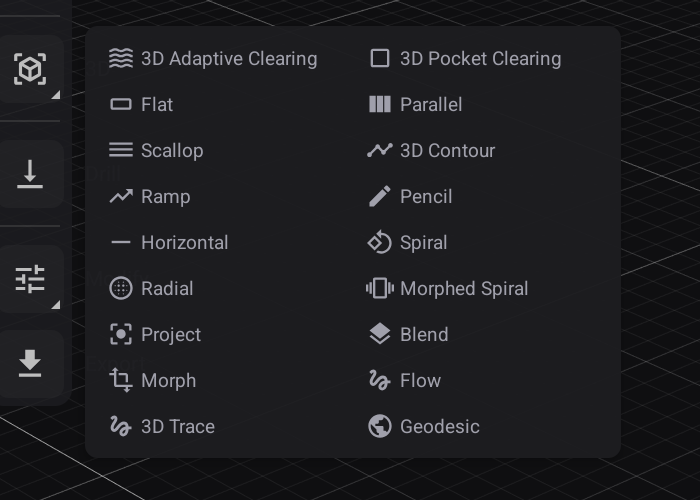
A 3D strategy follows the shape of a model rather than cutting to a flat depth. There are sixteen, and they split cleanly into two jobs.
Roughing — get the material off
The part is buried in a block. Roughing removes the bulk quickly and leaves a rough approximation of the shape.
| Strategy | Approach |
|---|---|
| 3D Adaptive Clearing | Constant cutter load, deep passes — the fast, tool-friendly default |
| 3D Pocket Clearing | Level-by-level clearing |
Finishing — make the surface
The shape is roughly there; now it needs to be right. Different strategies leave different marks, and the choice is mostly about how the tool meets the surface.
| Strategy | Best on |
|---|---|
| Parallel | Sweeps in one direction — good on shallow, open surfaces |
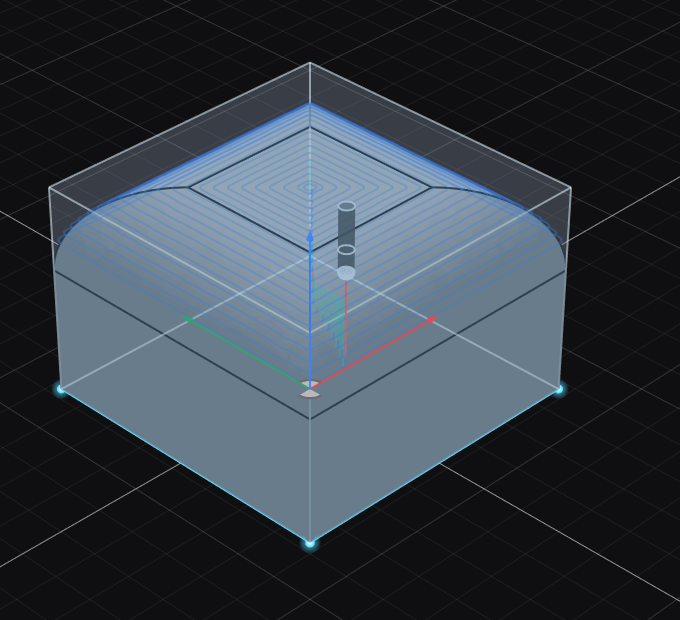
| Scallop | Constant stepover along the surface, so steep and shallow areas get the same treatment |
| 3D Contour | Level passes at constant Z — good on steep walls, poor on flats |
| Spiral / Radial / Morphed Spiral | Circular forms, following the shape rather than a grid |
| Horizontal | Level regions |
| Pencil | Runs along internal corners, cleaning what a bigger cutter left |
| Ramp | Descends gradually rather than plunging |
| Blend / Morph / Flow | Follows the surface's own flow between boundaries you choose |
| Project | Projects a path onto the surface |
| 3D Trace | Follows a curve across the shape |
The usual mistake
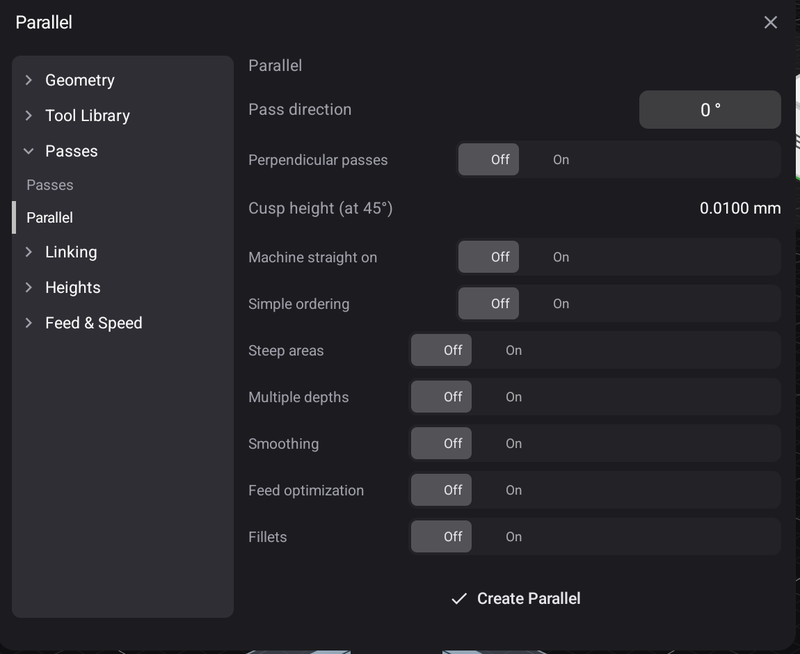
Parallel on a steep wall. Parallel sweeps in one direction at a fixed spacing measured across the part. Where the surface is steep, those evenly-spaced lines land far apart on the material, and the finish is dramatically worse than on the flats.
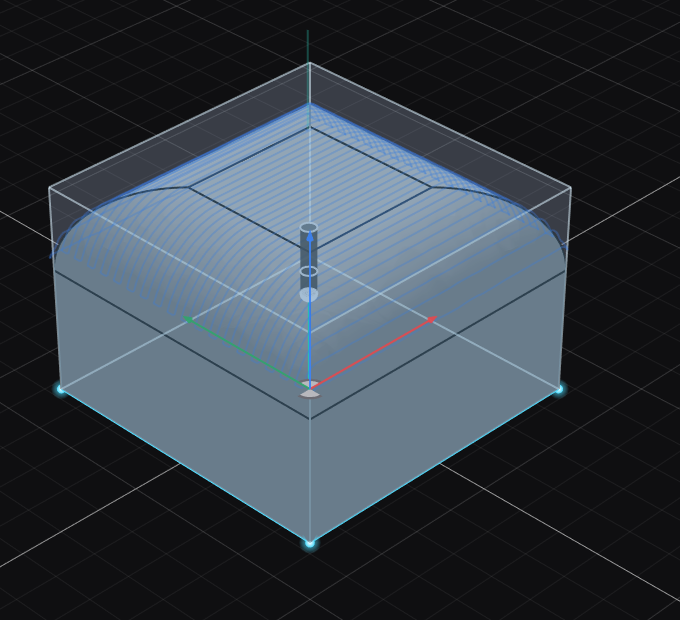
Scallop measures the spacing along the surface instead, which is why it holds a consistent finish on a shape that has both.
Combining them
A good result is usually two or three operations: rough it out, finish it, then clean the corners with something smaller.